14 Underrated US Destinations That Most Travelers Drive Right Past

My favorite trips are the ones nobody warned me about. Give me a place my friends have never heard of over a bucket-list stop with a two-hour line, because half the fun is coming home with a name people have to ask me to spell.
The country is stuffed with those places, spots that trade crowds for quiet wonder and reward you for looking past the famous names. Below, fourteen American destinations that punch far above their reputation, spread from an Oregon cliff to a Utah canyon and a Texas gorge.
1. Bear Lake, Idaho

People call it the Caribbean of the Rockies, and for once the nickname earns its keep. The water glows an unreal turquoise, and it is pure chemistry, not a filter. Springs seep through limestone and load the lake with calcium carbonate, which throws back the blue of the sky.
Straddling the Idaho and Utah line, Bear Lake stretches about 20 miles and stays crystal clear because it holds so little algae and sediment. The color even shifts through the day with the sun, the wind, and the current, so no two afternoons look quite the same.
Summer is for swimming, boating, and lazy hours on a paddleboard. When you climb out, the local ritual is a raspberry shake, thick enough to stand a spoon in, best enjoyed during the town’s Raspberry Days festival in August.
When you need a break from the sun, drive up to nearby Minnetonka Cave, a half-mile of limestone chambers so cool you will want a jacket even in July. It is the kind of one-two punch you rarely find in a place this quiet.
Where: Bear Lake State Park, near St. Charles and Fish Haven, Idaho, off US-89 on the Idaho-Utah border.
2. Bisbee, Arizona

Tucked into the Mule Mountains near the Mexican border, Bisbee once dug more copper than almost anywhere on earth. When the mines closed, artists moved into the empty houses, and today the old company town is a maze of galleries, cafes, and Victorian cottages stacked up impossibly steep hills.
The steep streets are the whole point. Locals climb them for the Bisbee 1000, an annual race up more than a thousand vintage staircases. You can wander those same stairs any day, ducking past mailboxes and gardens perched over the rooftops below.
For the story underneath it all, the Queen Mine Tour sends you deep into a real copper shaft on a rattling ore car, led by miners who once worked it. Back up top, the Copper Queen Hotel has poured drinks since 1902.
Where: Bisbee sits in southeast Arizona on AZ-80, about 90 minutes southeast of Tucson and just past Tombstone. Worth a stop:
- Queen Mine Tour, 478 Dart Rd, a guided ride into a real copper mine
- Copper Queen Hotel, 11 Howell Ave, the 1902 hotel anchoring downtown
- Bisbee Mining and Historical Museum, 5 Copper Queen Plaza, a Smithsonian affiliate on the main square
- Brewery Gulch, the walkable strip of bars, galleries, and coffee shops
- Old Bisbee staircases, the public stairways climbing the hillside neighborhoods
3. Hocking Hills, Ohio

Ohio does not get enough credit for its wild side, and Hocking Hills is the proof. Sandstone cliffs, mossy gorges, and recess caves make it feel more like a movie set than the Midwest.
Old Man’s Cave is the crown jewel, a mile-long trail that threads waterfalls, stone bridges, and a huge overhang. It takes its name from Richard Rowe, a hermit who really did live inside the cave in the early 1800s.
Spread your day across the wider park and you can add Ash Cave, the largest recess cave in the state, plus Cedar Falls and the honeycombed cliffs of Rock House. Come after a good rain and every waterfall shows off.
If one day is not enough, the surrounding hills are dotted with cozy cabins, and outfitters run zip lines and canoe trips down the Hocking River. It is an easy place to slow down for a long weekend.
Where: Hocking Hills State Park spreads across several trailheads near Logan, Ohio, about an hour southeast of Columbus. The stops worth linking together:
- Old Man’s Cave, the mile-long trail of waterfalls and stone bridges off State Route 664
- Ash Cave, the largest recess cave in the state, a short paved walk from the lot
- Cedar Falls, the park’s most powerful waterfall, a few minutes up the road
- Rock House, the honeycombed cliff corridor with window-like openings
4. Capitol Reef National Park, Utah

Utah’s five national parks get all the glory, but Capitol Reef, the quiet middle child, may be the best-kept secret of the bunch. A hundred-mile wrinkle in the earth called the Waterpocket Fold buckles the desert into cliffs, domes, and slot canyons the color of rust.
The surprise is green. Mormon settlers planted orchards here in the 1880s, and the park still tends them, so in summer you can pick cherries, apricots, and apples right off the branch. The tiny Gifford Homestead sells fruit pies that sell out by noon.
Lace up for the Hickman Bridge trail, an easy climb to a natural stone arch, or drive the back roads into Cathedral Valley, where sandstone monoliths rise straight from the flats. At night, some of the darkest skies in the country fill with stars.
Where: Capitol Reef National Park, on UT-24 near Torrey, Utah, about 3.5 hours south of Salt Lake City.
5. Solvang, California

Drop into Solvang and you would swear you had wandered onto a lane in Denmark. Danish American educators founded the town in 1911, buying 9,000 acres of the Santa Ynez Valley to keep their heritage alive.
Today four windmills turn over cobbled streets, and roughly half a dozen bakeries sell aebleskiver, round Danish pancakes dusted with sugar and served with jam. The whole town leans into it, right down to a copy of the Little Mermaid statue.
Better yet, some of California’s finest wine country sits right at the town’s edge, so a morning of pastry can roll straight into an afternoon of tasting. In September, the Danish Days festival fills the streets with folk dancing.
History hides between the pastry shops too. Old Mission Santa Ines, founded in 1804, still anchors the eastern edge of town, and a small free museum honors Hans Christian Andersen, whose fairy tales gave this whole storybook place its beating Danish heart.
Where: Solvang sits on CA-246 in the Santa Ynez Valley, about 45 minutes north of Santa Barbara. Worth a stop:
- The four working windmills scattered through the walkable downtown
- Old Mission Santa Ines, 1760 Mission Dr, founded in 1804 on the town’s east edge
- The Hans Christian Andersen Museum, 1680 Mission Dr, a small free tribute to the author
- Solvang’s Danish bakeries, where aebleskiver pancakes come dusted in sugar
6. Great Sand Dunes National Park, Colorado

Nobody expects the tallest sand dunes in North America to sit at the foot of snowcapped Colorado peaks, but that clash is exactly what makes this place unreal. The dunes climb up to 750 feet, a golden sea stopped cold against the Sangre de Cristo mountains.
The park hands you a rare permission slip: play in it. Rent a sandboard, climb a ridge, and slide back down the face. In late spring, snowmelt fills Medano Creek at the base into a wide, shallow beach where kids splash in the desert.
Stay past sunset. Far from any city glow, the park is a certified dark-sky spot, and on a clear night the Milky Way arcs right over the dunes. Bring shoes for the cooling sand and water for the climb, which is steeper than it looks.
Where: Great Sand Dunes National Park, 11999 Highway 150, Mosca, Colorado, about four hours south of Denver.
7. Palo Duro Canyon, Texas

Most people picture Texas as flat, and then the ground drops out from under them at Palo Duro. The second-largest canyon in the country splits the Panhandle open in bands of red, orange, and white rock, 800 feet deep and 120 miles long.
A scenic drive winds all the way down to the canyon floor, where trails branch off toward the Lighthouse, a slender rock spire that has become the symbol of the whole place. Roadrunners and wild turkeys cross the path like they own it.
On summer nights the canyon becomes a stage. The outdoor musical TEXAS has played beneath the cliffs since 1966, with fireworks and horses and a painted sunset backdrop nature threw in for free. It is a Panhandle tradition worth planning a trip around.
Where: Palo Duro Canyon State Park, 11450 Park Road 5, Canyon, Texas, about 30 minutes south of Amarillo.
8. Harpers Ferry, West Virginia

Perched where the Potomac and Shenandoah rivers crash together, this old town wears its history on every brick. Thomas Jefferson once called the view here worth a voyage across the Atlantic, and standing at the point, you get it.
The abolitionist John Brown staged his famous raid on the federal armory here in 1859, a spark that helped light the Civil War. The restored lower town lets you walk those same stone streets and duck into little shops and museums.
The Appalachian Trail runs right through town, which is why long-distance hikers treat Harpers Ferry as their psychological halfway mark. History buffs and thru-hikers end up sharing the same steps up to Jefferson Rock.
When you have had your fill of history, the two rivers hand you an afternoon of tubing, rafting, and flat-water paddling. Few towns let you stand inside a founding chapter of the country and then float away from it by lunchtime.
Where: Harpers Ferry sits where the Potomac and Shenandoah rivers meet, about 70 minutes northwest of Washington, DC. Worth a stop:
- The restored lower town, the stone streets of shops and museums by the water
- Jefferson Rock, the overlook Thomas Jefferson called worth a trip across the Atlantic
- The John Brown Museum, on Shenandoah Street, telling the story of the 1859 raid
- The Appalachian Trail, which runs straight through the middle of town
9. Natchez, Mississippi

Older than New Orleans and perched on a bluff above the Mississippi River, Natchez wears its history openly. Founded in 1716, it holds one of the richest collections of antebellum mansions in the South, and many still open their doors for tours.
The strangest and most striking is Longwood, a six-story octagonal house whose upper floors were left unfinished when the Civil War halted the work. Downtown, Stanton Hall fills an entire city block with columns and chandeliers.
Walk the bluff at sunset as the river turns gold, then head down to Natchez Under-the-Hill, the old riverfront strip now lined with easygoing bars and cafes. This is also where the Natchez Trace Parkway begins its 444-mile run north.
Where: Natchez sits on the Mississippi River in southwest Mississippi, about 90 minutes southwest of Jackson on US-61. Worth a stop:
- Longwood, 140 Lower Woodville Rd, the unfinished octagonal mansion
- Stanton Hall, 401 High St, a full-block Greek Revival home downtown
- Bluff Park, along Broadway St, the walk with wide views over the river
- Natchez Under-the-Hill, the historic riverfront strip of bars and shops
- The Natchez Trace Parkway, the scenic drive starting at the town’s edge
10. Yachats, Oregon

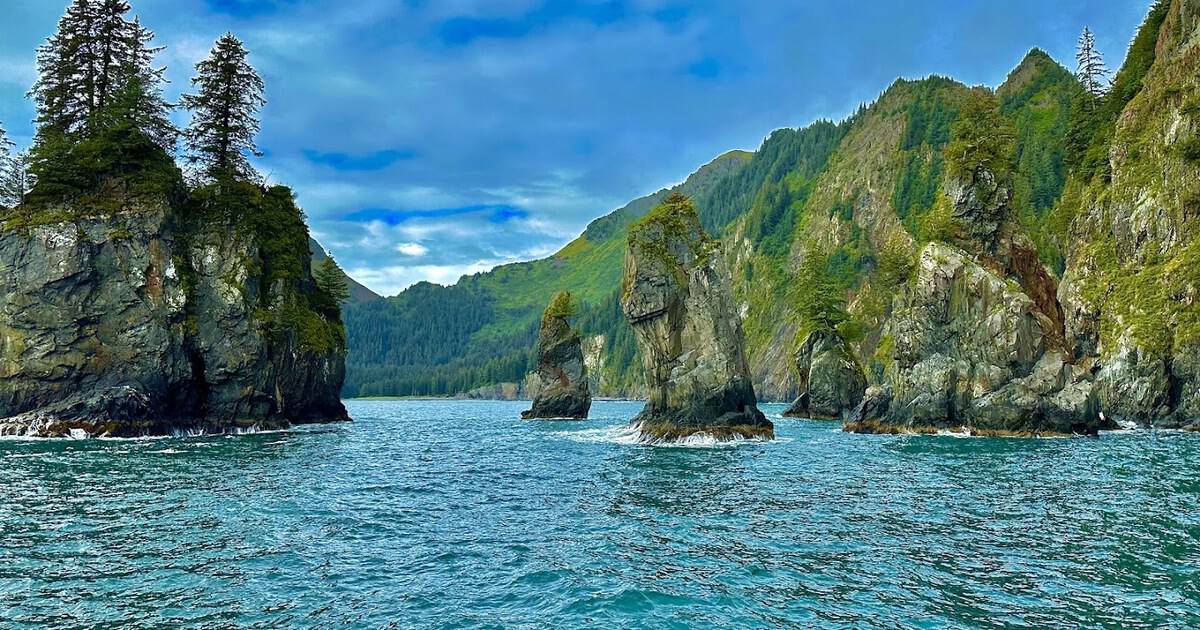
This tiny coastal town packs the most dramatic stretch of the Oregon shore into a few walkable miles. Just south sits Cape Perpetua, and its star attraction is Thor’s Well, a yawning hole in the rock that looks like the Pacific is being poured straight down a drain.
Time your visit for high tide and the show gets loud. A mile up the road, Devil’s Churn funnels each wave into a narrow slot until it erupts, and nearby Spouting Horn shoots seawater into the air like a geyser.
The top of the cape is the highest point you can reach by car on the whole coast, 800 feet up, with views running 40 miles out to sea. Behind it, a trail leads to a Sitka spruce that has stood for more than 500 years.
Down at sea level, the Cape Cove tidepools brim with orange starfish, green anemones, and darting shore crabs whenever the water pulls back. Gray whales cruise past just offshore in spring and again in winter, so pack binoculars and scan the horizon for a passing spout.
Where: Yachats sits on US-101 on the central Oregon coast, about three hours southwest of Portland, with Cape Perpetua just south of town. Worth a stop:
- Thor’s Well, the churning hole in the rock best seen an hour before high tide
- Devil’s Churn, where waves funnel into a narrow slot and erupt
- Spouting Horn, a sea vent that shoots seawater into the air
- The Cape Perpetua overlook, the highest coast viewpoint you can reach by car
- Cape Cove tidepools, full of starfish and anemones at low tide
11. Medora, North Dakota

Almost nobody plans a trip to North Dakota, which is exactly why Theodore Roosevelt National Park stays so blissfully empty. The badlands here ripple in bands of red, gold, and gray, and a 36-mile loop drive rolls you past all of it.
You will share the road with free-roaming bison, chattering prairie dog towns, and bands of wild horses. There are 95 miles of trails if you want to trade the car for your own two feet.
A young Roosevelt first came out in 1883 to hunt bison and ended up ranching this country, and he later credited it with shaping the conservationist he became. His restored Maltese Cross Cabin still stands near the visitor center.
In the little town of Medora, summer nights bring the Medora Musical, an outdoor variety show staged in an amphitheater carved into the hillside. It is corny in the best possible way, and the sunset behind the stage does half the work.
Where: Theodore Roosevelt National Park, South Unit, Medora, North Dakota, off I-94.
12. Chincoteague Island, Virginia

On a sleepy barrier island off Virginia’s Eastern Shore, wild ponies roam the marsh grass just as they have for centuries. Chincoteague is the friendly little town that guards the gate, all seafood shacks, ice cream stands, and screen doors clacking in the salt breeze.
The ponies actually live next door on Assateague Island, a protected refuge of empty beaches and shifting dunes. Every July, wranglers guide the herd across the channel in the famous Pony Swim, a tradition running strong since the 1920s.
Even without the ponies, the refuge is a joy. Climb the candy-striped Assateague Lighthouse, bike the flat wildlife loops at dawn, or just claim a stretch of undeveloped sand. Bring binoculars, because the birdlife here is some of the best on the East Coast.
Where: Chincoteague Island lies off Virginia’s Eastern Shore, reached from US-13 by way of VA-175, about 2.5 hours from Norfolk. Worth a stop:
- Chincoteague National Wildlife Refuge, home to the trails and the wild pony herds
- Assateague Lighthouse, the 1867 tower reached by a short forest path
- Tom’s Cove, the calm swimming beach on the refuge side
- Robert Reed Waterfront Park, on Main St, the spot to watch the sunset over the channel
13. Indiana Dunes, Indiana

An hour from downtown Chicago, the skyline gives way to something you would never expect in Indiana: towering sand dunes and 15 miles of Lake Michigan beach. It only became a national park in 2019, the country’s 61st, so most people have not caught on yet.
You can climb a dune, cool off in the lake, and spot some of the more than 350 bird species that pass through in a single day. Roughly 50 miles of trails wind through marsh, forest, and prairie behind the shoreline.
The park wraps around the older Indiana Dunes State Park, home to the tallest dunes and a slowly moving mountain of sand called Mount Baldy. For a lake that acts like an ocean, this shore is one of the great open secrets of the Midwest.
Serious hikers take on the Three Dune Challenge, a steep scramble over the park’s tallest dunes that rewards you with the Chicago skyline shimmering across the water. Bring water, because that soft sand fights back on the way up.
Where: Indiana Dunes National Park, near Porter and Chesterton, Indiana, along Lake Michigan.
14. Lookout Mountain, Georgia

Up on Lookout Mountain, Rock City Gardens has been delighting road-trippers since it opened in 1932. Frieda Carter laid out a trail through massive rock formations, planting wildflowers and tucking in gnome statues along the way.
You squeeze through a passage called Needle’s Eye, cross the Swing-A-Long suspension bridge, and duck into the glowing dioramas of Fairyland Caverns. Kids and grandparents tend to grin at the exact same spots.
The showstopper is Lover’s Leap, where on a clear day you can see seven states at once. If you grew up spotting “See Rock City” painted on barn roofs, this is the place those barns were pointing to all along.
Save time for the rest of the mountain too. Just down the road, Ruby Falls hides a 145-foot waterfall deep inside a cave, so you can watch the world from a cliff top and from underground on the very same day.
Where: Rock City Gardens, 1400 Patten Rd, Lookout Mountain, Georgia, just outside Chattanooga.
Start Planning Your Under-the-Radar Road Trip
The best souvenir is a place your friends have not discovered yet. Pick one of these, point the car toward it, and go while the crowds are still looking the other way.
You will come home with the kind of story that starts a dozen new travel plans, and a name nobody else at the table can pronounce. So grab a map, rope in a road-trip buddy, and let the quiet corners of the country surprise you.
Featured image: Stuart Carr via Capitol Reef National Park

Stella Raines
Editor-in-Chief
Stella brings over a decade of storytelling experience to TX Headlines. With roots in West Texas and a love for road trips, she leads the editorial team with an eye for the hidden stories that make Texas unforgettable.