12 Most Beautiful Places That Look Fake but Are Completely Real

I keep a running list on my phone of places that look fake in photographs. You know the ones. A friend sends a picture, you assume the colors were cranked up in an app, then someone who has actually stood there swears it looks even better.
This country is stacked with them, and I mean quiet, staggering beauty, the kind of scene that rearranges your idea of a good road trip. So this list skips the tired checklist and goes for real places worth crossing state lines to see.
Here is what you will get below: twelve of the most beautiful places in the country, spread coast to coast, each one a real spot you can plan a whole trip around.
One of them sits closer to home in Texas than you might expect. Reservations and timing matter at several, so I have flagged the smart window for each.
1. Antelope Canyon, Arizona

Picture a crack in the desert barely wide enough for your shoulders, where sandstone walls swirl overhead like frozen waves. That is Upper Antelope Canyon, a slot canyon on Navajo land just outside Page.
Near midday, sunbeams drop through the narrow opening and land on the floor like spotlights. The whole canyon glows amber, orange, and deep violet as the light slides across the stone. You enter only with a Navajo guide.
The light beams are strongest from late March to early October, roughly 11 a.m. to 1:30 p.m. Book ahead in peak season, since guided slots fill weeks in advance.
Where: Upper Antelope Canyon, off Highway 98 east of Page, Arizona. Every visit requires a Navajo-guided tour booked in advance.
2. Maroon Bells, Colorado

If you have ever seen two matching maroon peaks doubled in a glassy alpine lake, odds are you were looking at the Maroon Bells. They rise above Maroon Lake near Aspen, often called the most photographed mountains in North America.
The pull is the reflection. On a still morning the lake goes mirror flat, the two fourteen-thousand-foot peaks land upside down on the surface, and the aspens behind them turn gold in late September.
The little valley fills fast, so a reservation for the shuttle or trailhead parking runs from May into October. The short ride from Aspen Highlands drops you right at the lake.
Where: Maroon Lake, about 10 miles from Aspen, Colorado. Reserve a shuttle seat or a parking permit before you go.
3. Yosemite National Park, California

There is a pullout on the road into Yosemite Valley called Tunnel View, and it stops first-timers cold. In one glance you get El Capitan on the left, Bridalveil Fall on the right, and Half Dome standing at the back.
The valley was carved by glaciers into a sheer-walled cathedral of granite, with waterfalls pouring off the rims each spring. Meadows and the Merced River run along the flat bottom, so the giants tower straight overhead.
The waterfalls run hardest from April through June, then thin out by late summer. A reservation is often required to drive in during peak season, so plan the timed entry ahead.
Where: Tunnel View sits on Highway 41 at the west end of Yosemite Valley, California, about four hours east of San Francisco. Check the park’s reservation calendar before you go.
4. Turnip Rock, Michigan

Here is a scene that looks impossible until you spot the boat wakes around it. Turnip Rock is a tiny sea stack off the tip of Michigan’s Thumb, wide on top and pinched to a skinny waist by centuries of Lake Huron waves.
Trees sprout from its crown like a green mop, and the water around it runs so clear you can watch the rocky bottom drift past. All the shoreline is private, so the only way to reach it is across the water.
Most people paddle. It is roughly a seven-mile round trip by kayak from Port Austin, three to four easy hours on a calm day. Guided boat tours run shorter trips if you would rather ride.
Where: Off the shoreline near Port Austin, Michigan. Rent a kayak in town or book a captained boat tour, since there is no land access.
5. Hamilton Pool, Texas

Texas earns its spot with a swimming hole that looks like the roof of a cave gave way, because that is exactly what happened. Thousands of years ago an underground river collapsed and left a jade-green pool ringed by a fifty-foot limestone dome.
A slender waterfall spills over the lip and trickles down the mossy grotto walls into the water below. Ferns hang from the overhang, and even in a Texas August the shaded basin stays cool and green.
Hamilton Pool Preserve sits west of Austin and runs on timed reservations, one small fee per vehicle. Swimming depends on the water quality that day, so check before you count on a dip.
Where: 24300 Hamilton Pool Road, Dripping Springs, Texas, about 45 minutes west of Austin. Reserve a morning or afternoon entry online in advance.
6. White Sands National Park, New Mexico

Imagine a beach with no ocean, dunes rolling to the horizon in a white so bright it reads like fresh snow. That is White Sands, 275 square miles of pure gypsum, the largest gypsum dunefield on Earth.
The sand stays cool underfoot even in summer, which is how you end up sledding down the slopes on a plastic saucer in shorts. Sunset is the headliner, when the whole field turns pink and gold.
The park sits between Alamogordo and Las Cruces, easy to reach off the highway. Gates sometimes close briefly for testing on the missile range next door, so check the schedule before you drive out.
Where: White Sands National Park, on US Highway 70 between Alamogordo and Las Cruces, New Mexico.
7. Acadia National Park, Maine

New England folds its whole coastline into one park at Acadia, where pink granite mountains drop straight into the cold Atlantic. Spruce forest, glassy ponds, and a rocky shore all sit within a few miles of each other.
Drive or bike the Park Loop Road, then walk out to Jordan Pond with the two rounded peaks called the Bubbles reflected at the far end. Cadillac Mountain catches the first sunrise in the country for much of the year.
Fall lights the forest red and gold, usually peaking in early to mid October. Summer is busiest, so start early, and a timed reservation is needed to drive up Cadillac Mountain for sunrise.
Where: Acadia National Park on Mount Desert Island, Maine, reached through the town of Bar Harbor about three hours northeast of Portland.
8. Monument Rocks, Kansas

Kansas has a reputation for being flat, and then the prairie hands you this. Monument Rocks is a cluster of chalk towers rising as high as seventy feet straight out of the grassland, pale and sudden.
Also called the Chalk Pyramids, they were laid down around eighty million years ago, when a shallow sea covered the middle of the continent. Wind and rain have since carved arches and spires into the soft stone.
They were the first National Natural Landmark named in Kansas. The formations sit on private ranch land open to respectful visitors, free of charge, so tread lightly and bring your own water and shade.
Where: Monument Rocks, Gove County near Oakley, Kansas, reached by well-marked gravel roads. On private land open to visitors at no charge.
9. Glacier National Park, Montana

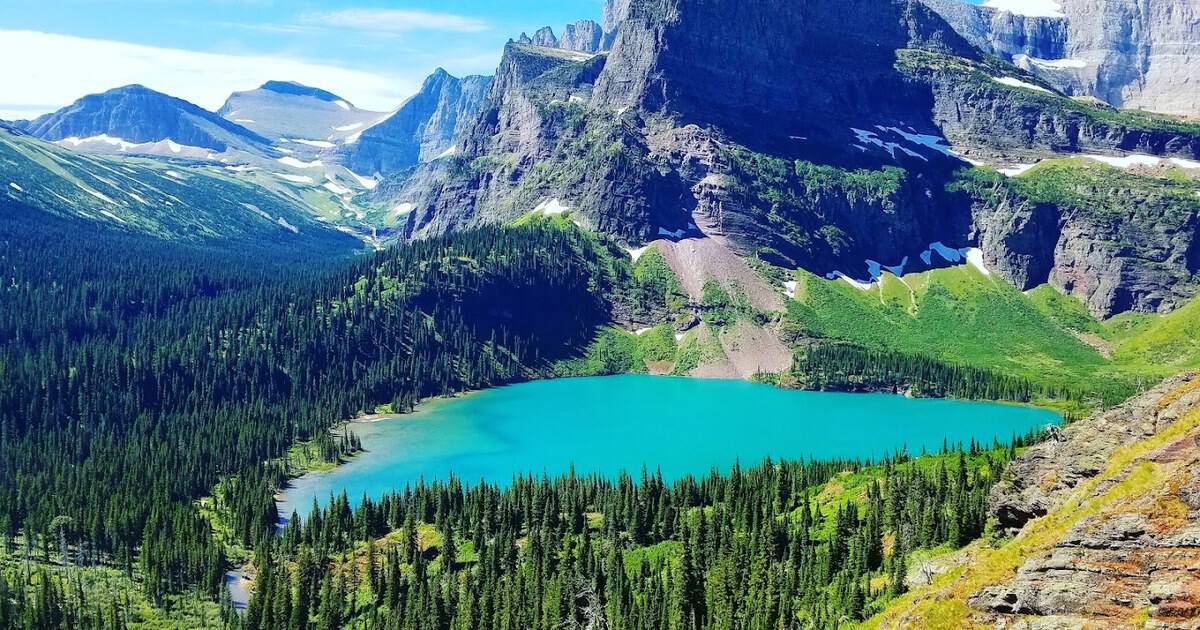
Montana keeps its masterpiece up high. Glacier National Park stacks jagged peaks over valleys of turquoise lakes, and a single ribbon of road, Going-to-the-Sun, threads right over the top of it.
Lake McDonald anchors the west side, its shallows paved with red and green pebbles you can see through the clear water. Glacier-fed lakes glow an unreal blue, and mountain goats watch from the ridgelines.
The high road usually opens by late June and closes with the first heavy snow. Go in July or August for full access, and start early, since the popular lots fill by mid-morning.
Where: Glacier National Park in northwest Montana, with the west entrance at West Glacier off US Highway 2, about 30 minutes from Kalispell.
10. The Palouse, Washington

Some landscapes are loud. The Palouse is a slow, rolling hush. In eastern Washington, thousands of grassy hills pile up like green and gold velvet, folded into curves so smooth they barely look real.
These are dunes of ancient windblown soil, now planted in wheat and canola that shift color with the season. The best overview is from Steptoe Butte, a rocky knob standing 3,600 feet above the patchwork.
Late June paints the hills their deepest green, while August turns them harvest gold. Drive up near sunrise or sunset, when low light rakes across the folds and every ridge casts a long shadow.
Where: Steptoe Butte State Park, about 12 miles north of Colfax, Washington, at the heart of the Palouse farm country. The drive to the top is paved.
11. Badlands National Park, South Dakota

Drive across the South Dakota grassland and the earth suddenly drops away into a maze of striped spires and ridges. The Badlands look almost painted, banded in rust, gold, and pale rose that shift as the sun moves.
The colors are layers of ancient sediment, eroding about an inch a year into buttes and canyons. Bighorn sheep and bison roam the mixed-grass prairie on the rim, and the night sky here is famously dark.
The Badlands Loop Road strings together the best overlooks in a single easy drive. Early morning and late afternoon set the whole formation glowing, so time your visit for the soft light.
Where: Badlands National Park, off Interstate 90 near Wall, South Dakota, about an hour east of Rapid City. The Loop Road links the main overlooks.
12. Dry Tortugas National Park, Florida

Almost 70 miles past Key West, where the Gulf meets the Atlantic, a ring of tiny islands sits in water so clear and blue it hardly looks real. This is Dry Tortugas, one of the least-visited national parks in the country.
A massive nineteenth-century fort, Fort Jefferson, fills one island almost edge to edge, its brick walls circled by turquoise shallows and coral reefs. Snorkelers drift over the moat wall while frigatebirds wheel overhead.
The only way out is by ferry or seaplane from Key West, so a visit takes planning and a whole day. Calm summer seas make the crossing smoothest and the snorkeling clearest.
Where: Dry Tortugas National Park, reached only by ferry or seaplane from Key West, Florida. Book the boat or flight well ahead, since daily spots are limited.
Start Planning Your Most Beautiful Detour
The best part of a list like this is how spread out it is. You could build a whole summer around it, or just pick the one that is a reasonable drive and go stand in front of it this year.
Whether you aim for a Texas grotto, a Kansas prairie, or a canyon full of light, check the reservations first, since several of these spots now cap the daily crowd. Then go see it in person, because every one looks even better than the photo.
Featured image: Drew Tj via Maroon Bells

Stella Raines
Editor-in-Chief
Stella brings over a decade of storytelling experience to TX Headlines. With roots in West Texas and a love for road trips, she leads the editorial team with an eye for the hidden stories that make Texas unforgettable.